Fishing & Tying The Rusty Spinner
We are on the Bighorn River in Montana this week and one of our go-to flies is a size 16 rusty spinner. This is a  pattern that we have many of in our fly boxes from home in Pennsylvania, and in our western boxes. When you think about it, rusty spinners should have a prominent place in every fly box. This spinner, tied in various sizes and shades represents numerous mayflies found on rivers and streams, both east and west, in this country and in others.
 The mayflies that come first to mind that have a rusty-like spinner for the final stage of life are Quill Gordon, Hendrickson, March Brown, Blue Winged Olive, Slate Drake, PMD, and Brown Drake. There is some variation in the size and shade of “rusty” in each of these mayflies but they all fall into the general grouping of rusty, red-brown or mahogany spinners.
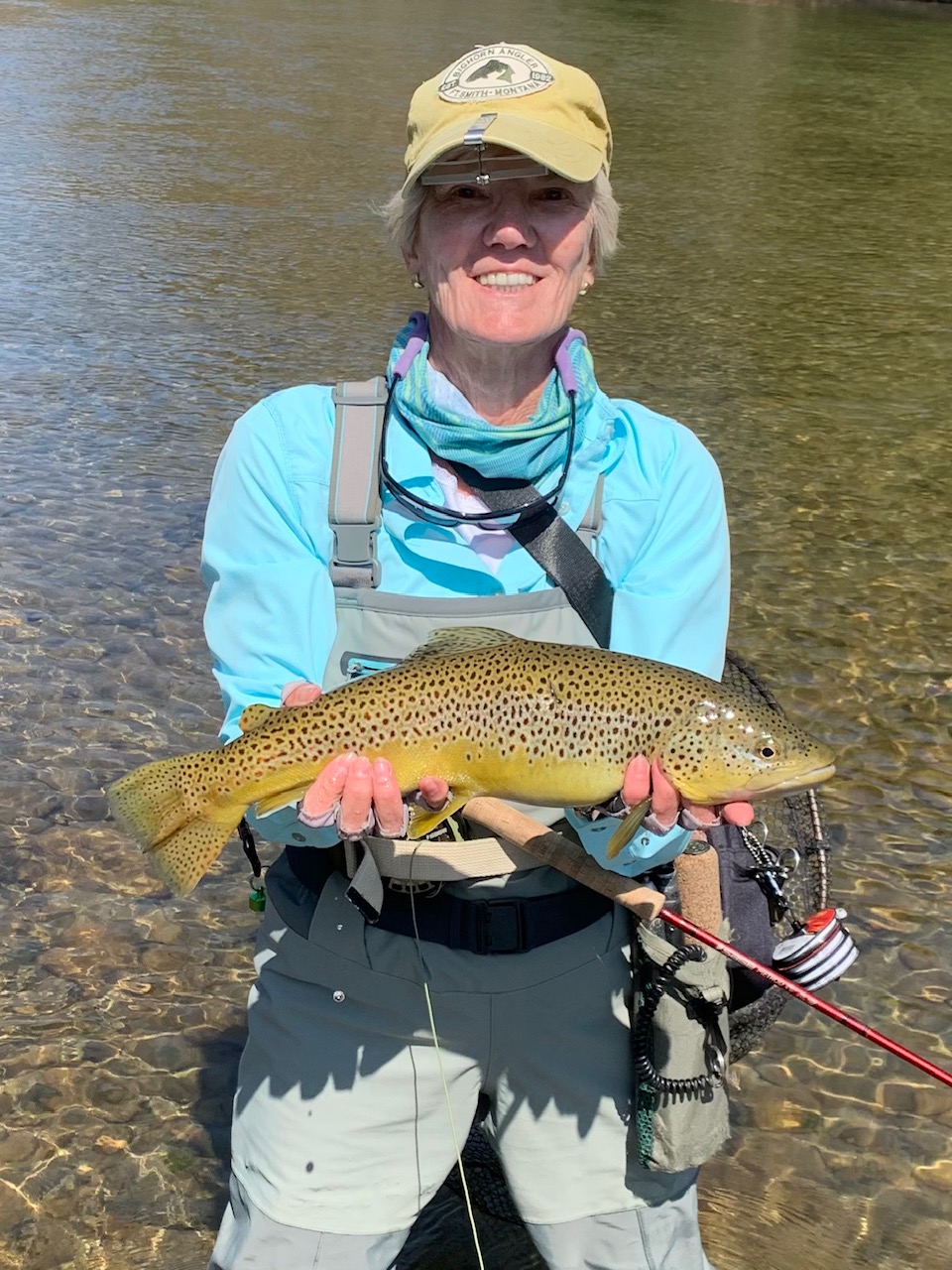
Some days are hot and breezy and the hopper fishing can be lots of fun, but there are calm warm days this week and that brings out the PMDs (Pale Morning Duns) and PMD spinners. Today we caught fish on three different shades of rusty and three different hook sizes. Our guide, Clint Krumm, agreed that it is a “go-to” fly for him on the river. Here it represents the pseudocloeon (pseudos), the PMD, and mahogany mayflies. Even when the flies are not hatching and spinners are not on the water, the fish are used to seeing the flies and will often take a spinner when it is offered.
The weather today was overcast because of forest fire smoke in the west and glare on the water was bad making the slender spinner profile hard to find. Our solution was to tie on a larger size 14 poly wing spinner with a size 16 hen wing spinner as a dropper. The light reflected off the poly wing making it easy to locate and sometimes the fish would take the larger spinner and other times the smaller. When the smaller spinner was chosen, the larger fly acted as a strike indicator, but whenever I saw a fish rise close to the larger spinner I set the hook and most of the time it resulted in a hook-up. We often use the same technique when fishing small hard-to-see flies at home – a bigger fly that can be easily seen and a small fly as a dropper. 
Our favorite rods are 9 foot, 5-weights for dries and 6-weight for nymph fishing. Leaders are about 9 feet long and usually 5X leaders. We have Sage Sonics with us and these rods have been lots of fun to fish, very responsive and accurate, and in a $550 price range, they are one of the best values in a mid priced multi-purpose fly rod.
In this article for Fly Fisherman, renowned author, fly tier and angler, Renee Harrop, talks about the rusty spinner imitating at least 13 mayfly hatches. Renee is a legend on western rivers like the Henry's Fork and no one knows bugs and the river better. It's a fascinating read.
While Lunn's Particular (referenced in the link above) may be a proven fly, we often use a simple poly fluff spinner tied with a little red brown dubbing and a micro-fibett tail. Tim Flagler ties a variation of this simple pattern in his video. If you Google the rusty spinner you'll find many variations. It's a pattern that can be simply tied.....or not. Either way it's a very effective fly, easily tied, easily fished, and is almost always the right choice. You can find rusty and red brown spinners, micro-fibetts and white or light dun poly fluff wing material in our online store.
We will have a Bighorn Report next week with photos from the two weeks. We have had perfect weather, good water, and good fishing. We love the Bighorn River Lodge! Here are a few shots until next week.


 Last chance to jump on the plane and enjoy a week of beautiful fall fishing in the Pyrenees. We have a couple rooms available. Borders are open and visitors are arriving. Come join us.
 I discovered Hemingway's book on the
  This is a book for those long quiet winter nights....which are coming quickly.
  That kind of fishing is unheard of around here in most Augusts! And it looks like it’s going to continue right through fall. For the next month, (August 26-September 26), we’re celebrating with $100 off our guiding fee for one or two anglers. It’s a great deal, includes guiding on private water, lunch, and any equipment that you might need.
  hopper dry fly with a dropper nymph. One fly floats and one sinks. Leave the 6X that you used a week ago on the #18 sulphur spinners in your pocket. Tie that hopper on a 4X leader so the cast turns over easily and depending on the depth of the water, add 14-24 inches of 4X tippet with a simple clinch knot to the bend of the hopper remembering that the longer the dropper tippet, the slower your cast should be to keep everything out of trouble.


 In the early mornings we are see fish rising to left over spinners from the night before but most of the action is on nymphs such as the pheasant tail (my favorite is a size 18 bead head), mop flies, ug bugs or yellow brown stoneflies, squirmy wormies, zebra midges and Perdigon nymphs to name a few that seem to be catching the most trout.


 The word is that we will be okay on the Bighorn because it's a tail water fishery. The water is coming out cold, clear, and low – which is good for the 'Horn at this time of year.
 We have a couple rooms available on our E. Pyrenees trip to Spain, Sept. 14-22. This is a trip for anglers and non-anglers with lots of good fishing and good sightseeing for non fishing companions. From tail waters to high mountain streams, fall is a beautiful time of year to be in Spain. Excellent food, wine, and fishing.
  We fly in and out of Barcelona and it's easy to extend your trip to see the city or to visit other parts of Spain. Please email us to request a brochure or more information.
 You may have read in an earlier blog that I decided this spring to get better at euro nymph fishing. Our guides were all doing it, exchanging stories, and it was clear that they liked it. I wanted to be part of that new energy, to take part in the conversations, be part of the group, so I got Tom & Jim, two of our guides, to help set up an outfit. It included the
  getting better at reading the 2-tone leader and have to say that I like the indicator tippet. The other thing that I really like though is the tippet ring and we are now using them on all of our rods. It makes managing the tippet so much easier and protects the leader. We're using tippet rings in all of our classes and I think that it helps a new angler in understanding tippet and leaders.
 A friend and client sent us the following article. It seems that the west is not only dealing with drought and wild fires, but with a grasshopper invasion as well. It's hard to believe that there can be this many hoppers and it doesn't sound like a good thing, but we have to hope that we find them in mass on the Bighorn when we get there in a few weeks. It could be some amazing fishing!
 One room for one or two persons has just become available with us at Turneffe Flats Lodge, Belize, October 16-23, 2021. Bonefish, permit, snook, tarpon, and diving. Great destination for a non-fishing partner. Check out the itinerary and then grab it before it's gone!
 We still have a pretty good inventory of Copper Johns on sale. It's a great time to stock up! Here's the repeat from a couple weeks ago:
 to summer, warm air and warmer water temperatures – which are now upon us. At this time of year, it's important to know what's happening to the immediate environment of the fish that we're going after.
 If you haven't looked around the Keep Fish Wet website, please do so. It's not a finger pointing, you're doing it wrong site. It's there to help us better understand fish and to help us be better stewards of the sport we fight so hard to protect and preserve. It's got good, solid, interesting information for us. Start with taking a look at this short article and go from there.


 back on track now.
 While we were pulling out our hair in the office, our guides kept doing what they do best and that is getting clients into fish. We've continued to have a very good season with lots of honorable-mention trout. Take a look at some of the photos below. The stream fished well and has been in great shape since March. Jim will fill us in on the details below.
 .
. Mid day is a great time to fish the green inch worm. It's one of my favorite flies to fish and the trout are
 starting to love it. You can fish it a host of ways. Dry fly drop or hopper drop is one of the most popular ways to fish it. It works well indicator nymphing or euro nymphing. My favorite way is to sight fish it in slow moving pools.
 Spain opened its borders to fully vaccinated travelers from most countries, including the United States, on June 7. Museums, restaurants, cafes, concert halls, and beaches are all open but without the crowds, at least for awhile. Sounds like a perfect time to plan a vacation to this beautiful country.
 company into an international powerhouse.


 patterns (poly fluffs and cdc thorax duns), so are offering our parachute duns, klinkhammers, low profile caddis, and tungsten orange butt nymphs at great savings.
 payment via Paypal to

 being able to recognize what the insects are doing will help us select the correct fly.


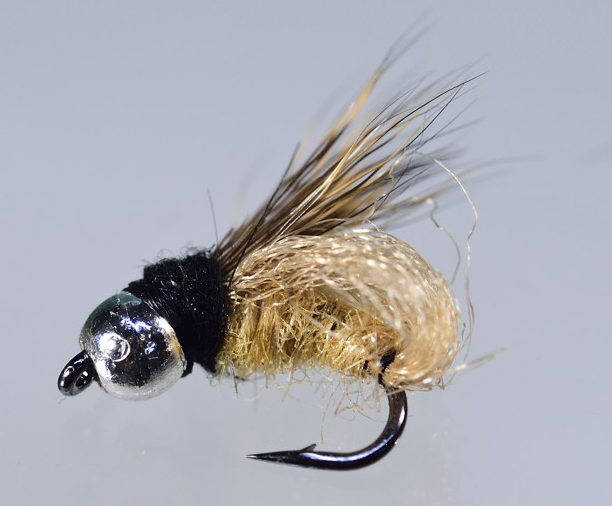
 alphabetically, so be sure to browse the dry flies and nymphs & emergers. We're excited to see how well the poly fluff duns are doing. Barry says “Poly fluff flies are tied to catch fish – not just fishermen. They're buggy and they work”
 We have one room at each lodge for either 2 anglers at double occupancy (shared room, shared boat), or a single angler at single occupancy. Although the itineraries are not showing current dates, please refer to the 2020 information on our web site. Except for dates and a slight price adjustment, information is correct. Contact us for further information.


 It's been a busy week on the stream with guiding, and the fishing has been good. We are seeing caddis, blues quills and Hendericksons with hatches starting in early afternoon. Mother nature has been throwing us a curve ball with one nice spring day and the next day resembling winter with wind, rain and cold.
 several nice trout being brought to the net.
 I had high expectations for more dry fly fishing on Tuesday especially since the weather was a lot nicer. Although we saw hatches starting just before noon, nothing really developed bug-wise. Late afternoon size 16 and 18 bead head euro nymphs were the flies of the day and of course the size 16 caddis emerger.
  All in all it’s spring time in Pennsylvania and snow flurries are in the forecast tonight and tomorrow morning. Last year at this time in a snow blizzard I saw an awesome Henderickson hatch. I'm anxious to see what tomorrow brings on the stream. The fish are hungry and it's a great time to be on the water.
 A few years ago when we were in Slovenia we fished a similar style and I remember struggling to cast because it was all monofilament. I slowly got the drift and by the end of the week I had it worked out. My arm was killing me, but I was able to catch fish. However, I have to admit that our excellent guide, Tina Possnig, could see the fly and the fish and would would yell “strike” so I just waited to be told. I could see fish moving but could not tell which one had picked up the fly. She could.
 Early April fly fishing here on Fishing Creek has been very good with some really nice trout caught and a fair amount of action throughout the day. Each day we were seeing more and more insect activity including the early black stones, blue quills and Hendricksons. That was right up to last Sunday rain which brought the creek up and for the next few days a sinking tip line and Cathy’s super buggers brought several nice trout to the net.


 Monday gave us sunshine and warmer temperatures and the fish were definitely more active and so were the insects. A few blue quills and a steady hatch of early black stones around mid day. Tuesday and Wednesday provided warmer temperatures and each day we saw more blue quills, black stone flies and a few Hendrickson duns with some rising fish around mid day. Water temperature on Wednesday rose to 53 degrees with some guys landing a few trout on dry flies.





 We haven't featured anything from Troutbitten lately and this is a great article about presentation and when the trout decides to reject or accept our fly. Gives us something to think about as we're mending our line and fooling around with the cast before it reaches the fish. Thank you, again, Domenick. You make us think.
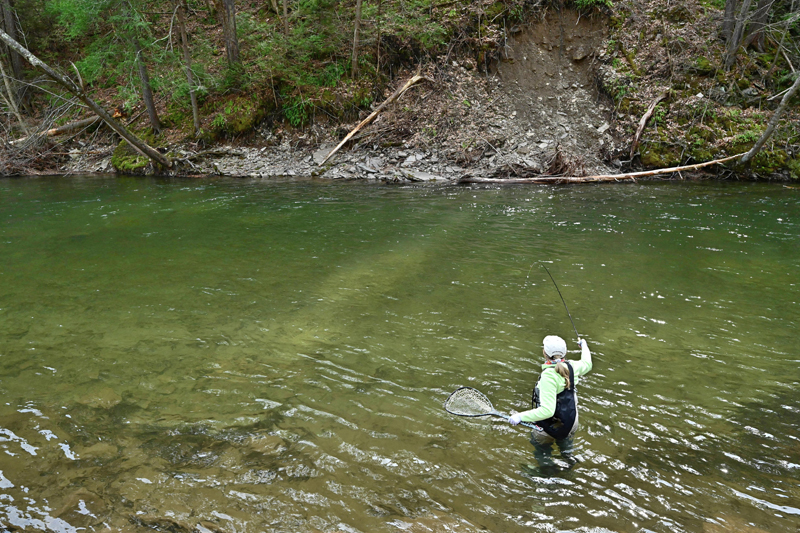
 to schedule a day or two with one of our guides. In the photo is Dave Lownder who fishes with us often.